# Platform Updates 2026

{% updates format="full" %}
{% update date="2026-06-01" tags="feature,improvement,fix,new-releases,improvements,fixes" %}

## Guardian 3.6.0

**Announcing Hedera Guardian 3.6**

The [Hedera Guardian 3.6 release is now available](https://github.com/hashgraph/guardian/releases/tag/3.6.0). Policy authors and registry operators managing policies in production and on Hedera mainnet need confidence that their policies keep working as intended. That means teams are investing more in authoring, validation, and operations. This release introduces Policy Integrity Tests to ensure policies continue producing expected outputs as they evolve or as the Guardian platform changes. It also adds runtime parameter editing, reducing the overhead of managing live integrations. Community contributors added multi-factor authentication, schema tooling improvements, and expanded developer API support.

### Policy Integrity Tests

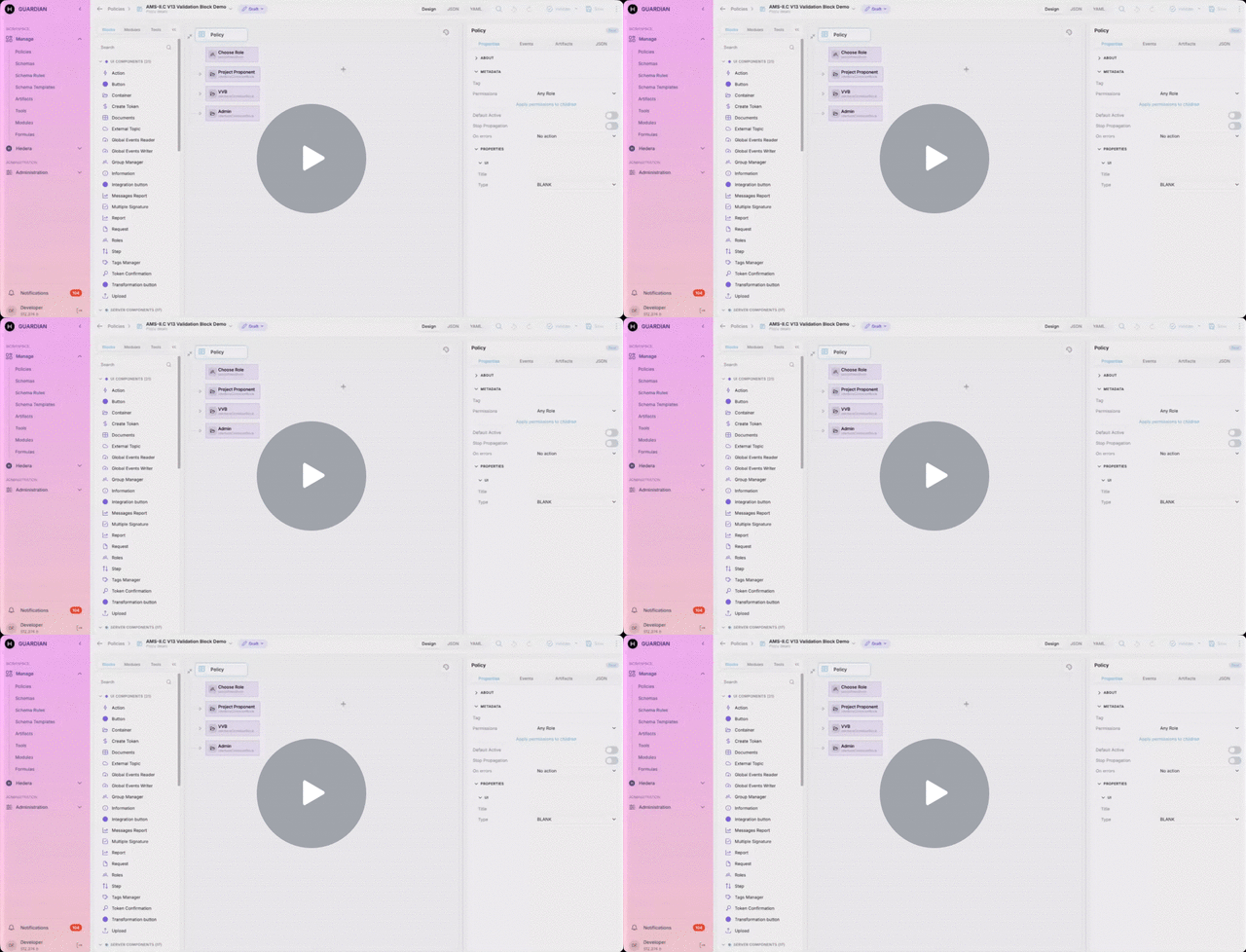
\[INSERT SCREENSHOT]

Standard registries and registry operators now have a native way to verify that policies continue to produce the outputs they were designed to produce — even as policies are edited, Guardian versions change, or platform dependencies shift.

Building on Guardian's existing record-and-replay capability, Policy Integrity Tests let authors declare scope: the input documents submitted to the policy, and the specific output documents expected in return. When a test runs, Guardian evaluates whether the declared outputs match — passing if they do, failing with inspectable detail if they don't. This makes tests stable across edits and upgrades — they only fail when the logic the author actually cares about changes.

Tests are saved as named baselines and can be re-run at any point: before publishing a policy edit, after a Guardian upgrade, or as part of a regular integrity check. Tests are accessible from both the UI and the API, and results are managed from a single dialog with pass/fail status and inspectable output.

\[Link to Docs]

&#x20;([#5910](https://github.com/hashgraph/guardian/issues/5910), [#5911](https://github.com/hashgraph/guardian/issues/5911), [#5912](https://github.com/hashgraph/guardian/issues/5912), [#5913](https://github.com/hashgraph/guardian/issues/5913), [#6020](https://github.com/hashgraph/guardian/issues/6020), [#6002](https://github.com/hashgraph/guardian/issues/6002), [#6021](https://github.com/hashgraph/guardian/issues/6021))

### Adjust Policy Parameters without Republishing

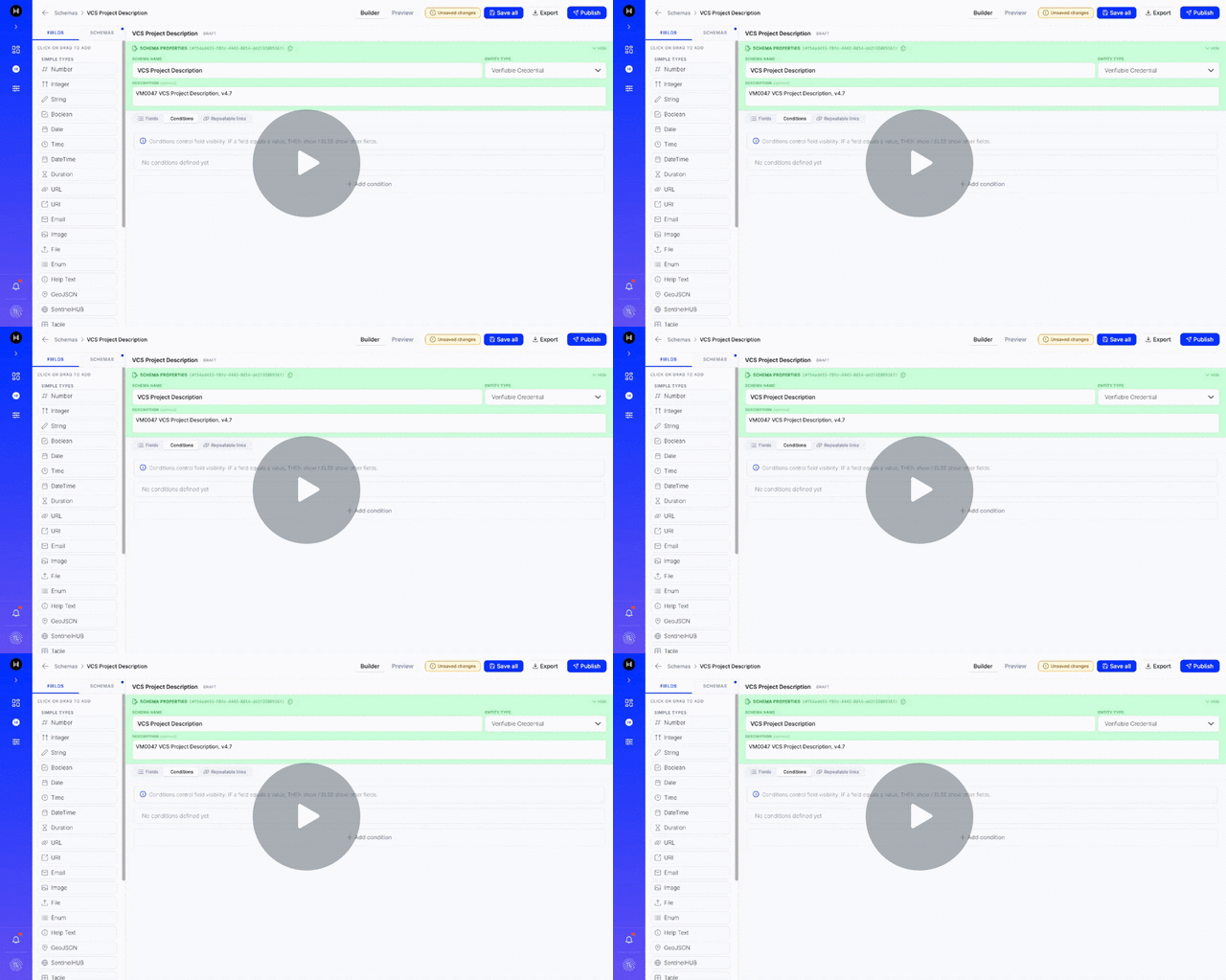
\[INSERT SCREENSHOT]

Standard registries and registry operators frequently need to adjust policy parameters — calculation thresholds, deadline windows, configuration inputs — after a methodology is already running at scale. Until now, any such change required publishing a new policy version, which meant data migration overhead and operational disruption to active policies. With this release, policy authors can designate specific parameters as runtime-editable, allowing authorized users to update values in place without touching the policy version or migrating historical data. Active methodologies continue running uninterrupted, and the change is reflected immediately without republishing.

\[Link to Docs]

### Easier Integrations

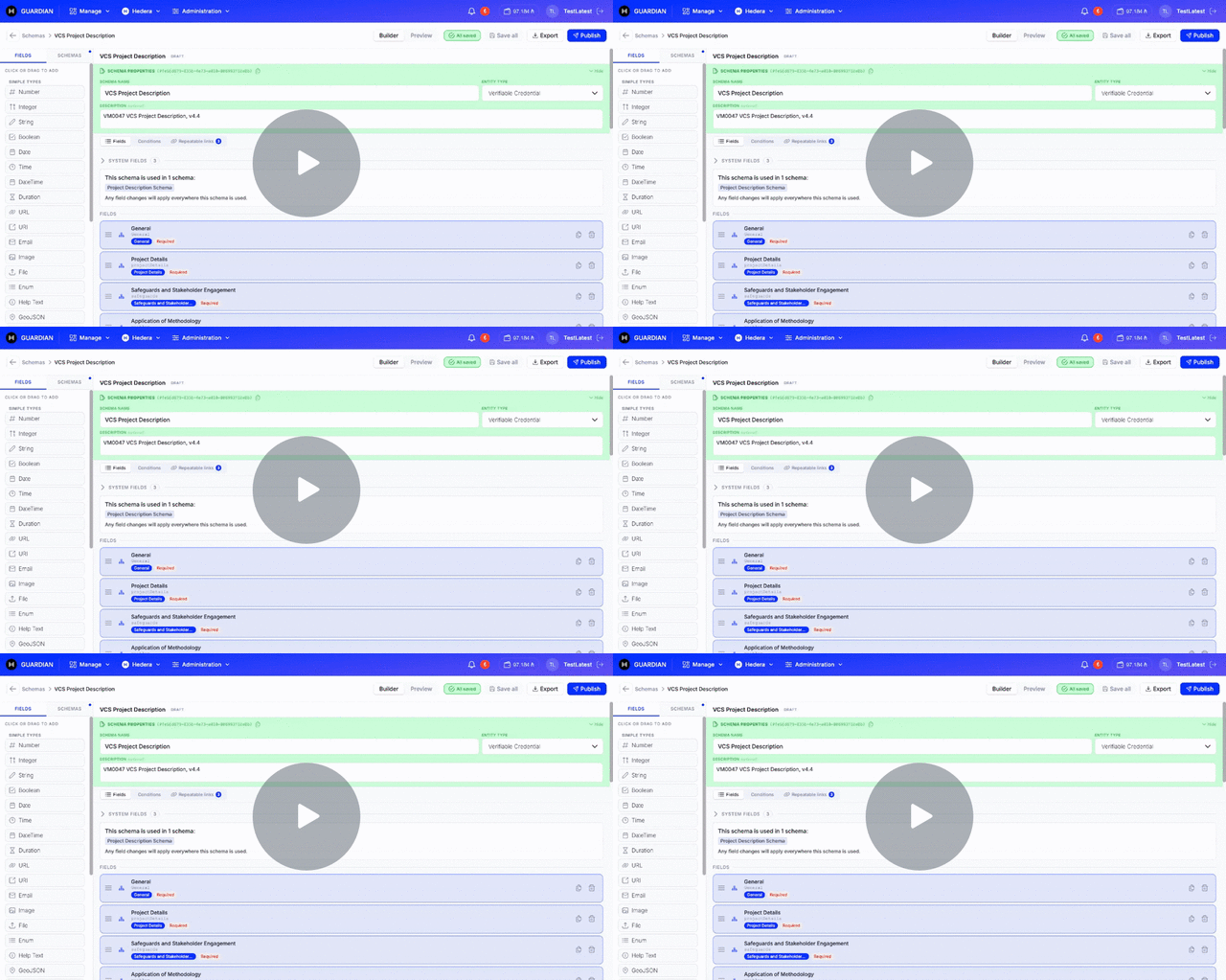
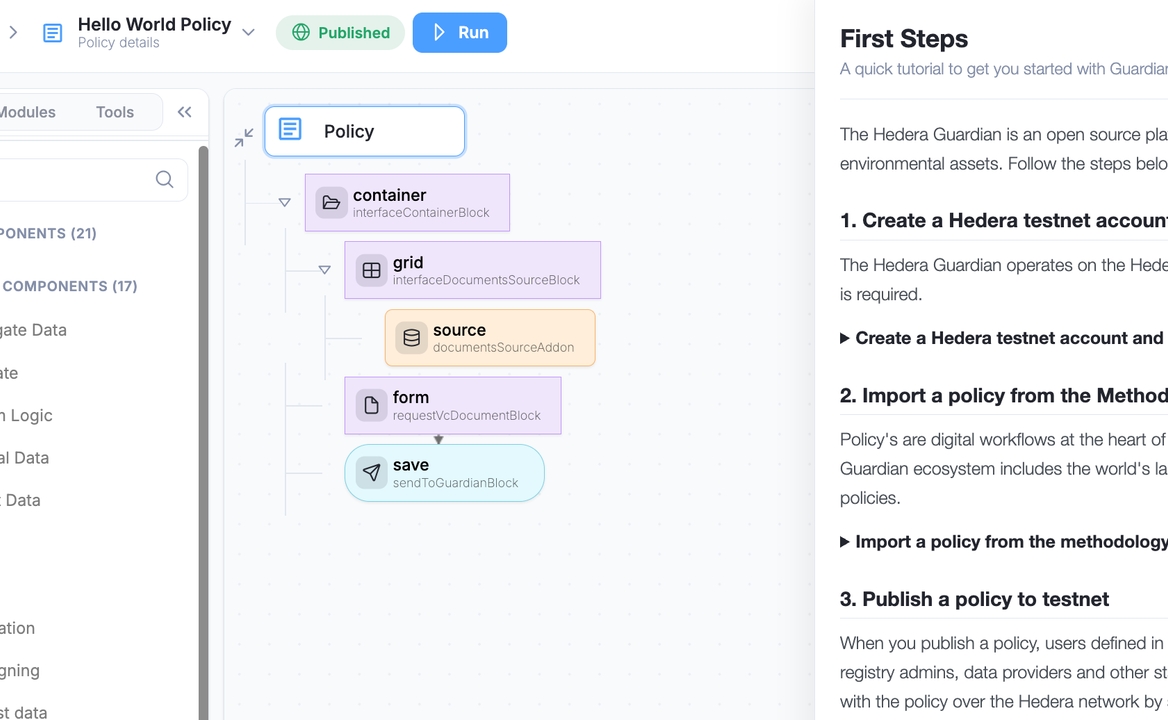
This release takes a meaningful step toward making Guardian easier to integrate with. Setting up a new user now takes a single API call instead of three chained operations, policy block documentation is auto-generated so it's always accurate, and block completion events let external systems react to policy execution without polling. Token transfers are now directly accessible outside policy workflows, and top-level convenience methods cut the boilerplate for common tasks. For developers integrating with Guardian, that's a noticeably lower barrier across the board.&#x20;

\[Link to Docs]

([#5795](https://github.com/hashgraph/guardian/issues/5795),[ #5955](https://github.com/hashgraph/guardian/issues/5955),[ #5799](https://github.com/hashgraph/guardian/issues/5799),[ #5800](https://github.com/hashgraph/guardian/issues/5800),[ #1987](https://github.com/hashgraph/guardian/issues/1987),[ #3642](https://github.com/hashgraph/guardian/issues/3642))

### New Features

* Top-level API convenience methods for common tasks are now available, reducing boilerplate for external integrations ([#1987](https://github.com/hashgraph/guardian/issues/1987)).
* Policy Block API documentation is now auto-generated directly from block configurations, so external developers always have documentation that reflects the actual implementation ([#5955](https://github.com/hashgraph/guardian/issues/5955)).
* The Math Block (aka formula calculation block) now supports nested arrays, multiple conditions, and special characters in variable names, with additional Formula Linked Definition (FDL) usability improvements ([#5928](https://github.com/hashgraph/guardian/issues/5928),[ #5980](https://github.com/hashgraph/guardian/issues/5980)).

<details>

<summary>Bounties &#x26; Community Contributions</summary>

This release includes a broad set of enhancements contributed through our bounty program and community. Big thank you to the teams at \[Xeptagon, Climission, Atec, … ]

* Multi-Factor Authentication is now supported for Guardian logins ([#4108](https://github.com/hashgraph/guardian/issues/4108)).
* Schema tooling additions include sub-schema creation and assignment, a fix for policy binding assignment, the ability to disable policy rebinding in already-created schemas, and filter/search for schemas by ID ([#4887](https://github.com/hashgraph/guardian/issues/4887),[ #4913](https://github.com/hashgraph/guardian/issues/4913),[ #4919](https://github.com/hashgraph/guardian/issues/4919),[ #4758](https://github.com/hashgraph/guardian/issues/4758)).
* API documentation for external developers is expanded, and the Indexer now includes a dedicated view for diving into external MRV data ([#5178](https://github.com/hashgraph/guardian/issues/5178),[ #5167](https://github.com/hashgraph/guardian/issues/5167)).
* A new external event is emitted on token mint failures; Python library support in custom logic blocks is extended; token minting rounding is now configurable; policy import includes search; refresh tokens now default to a one-year expiry ([#5108](https://github.com/hashgraph/guardian/issues/5108),[ #5504](https://github.com/hashgraph/guardian/issues/5504),[ #4065](https://github.com/hashgraph/guardian/issues/4065),[ #3378](https://github.com/hashgraph/guardian/issues/3378),[ #4060](https://github.com/hashgraph/guardian/issues/4060)).
* Expressions can now be written using placeholder code within Schema UI on import, Worker Tasks are added to the permission modal, and the Dry Run API user listing is corrected ([#4905](https://github.com/hashgraph/guardian/issues/4905),[ #4438](https://github.com/hashgraph/guardian/issues/4438),[ #3642](https://github.com/hashgraph/guardian/issues/3642)).
* Xeptagon (Sustainability Atlas) contributions add API endpoints for token transfers outside policy workflows, block completion events to the Guardian event stream so external systems can react when policy blocks finish execution, and one-step API user onboarding that auto-generates a Hedera account, DID, and keys in a single call ([#5800](https://github.com/hashgraph/guardian/issues/5800),[ #5799](https://github.com/hashgraph/guardian/issues/5799),[ #5795](https://github.com/hashgraph/guardian/issues/5795)).

</details>

<details>

<summary>Bug Fixes</summary>

* Retry failed mint and transfer operations directly from the policy viewer ([#5926](https://github.com/hashgraph/guardian/issues/5926))
* IPFS misconfiguration no longer causes profile setup to hang indefinitely with no useful error message ([#5992](https://github.com/hashgraph/guardian/issues/5992)).
* CustomLogicBlock no longer receives a mutated document in event-driven fan-out scenarios, which previously caused unpredictable downstream behavior ([#5953](https://github.com/hashgraph/guardian/issues/5953)).
* Guardian now correctly creates a new initialization topic when INITIALIZATION\_TOPIC\_ID is not defined ([#4959](https://github.com/hashgraph/guardian/issues/4959)).
* The policy publication status page now remains reachable after navigating away and returning, and the notifications badge counter is corrected ([#5695](https://github.com/hashgraph/guardian/issues/5695),[ #5699](https://github.com/hashgraph/guardian/issues/5699)).

</details>

***

Explore the latest updates, join our next event, and share your thoughts with us. Your feedback plays a crucial role in helping to improve Hedera Guardian for everyone.

<a href="https://luma.com/guardian?utm_source=gitbook" class="button primary">Join our next event</a>
{% endupdate %}

{% update date="2026-05-15" tags="feature,improvement,fix,events" %}

## Training Recap

**Developing Digital Methodologies with Guardian: VM0050 and VM0047**

<figure><img src="/files/xSJ9Q2CGsoEih2CECKGj" alt=""><figcaption></figcaption></figure>

Over two sessions in April and May, [Jailine Molina](https://www.linkedin.com/in/jailine-molina/), Lead Environmental Solutions Lead at [Hashgraph](https://www.hashgraph.com/) and [Waqar Ashiq](https://ca.linkedin.com/in/waqar-ashiq-2b410193), Senior Program Officer at [Verra](http://verra.com/) walked methodology developers through what it takes to digitalize a Verra methodology end to end using the Hedera Guardian — from reading the standard to a production-ready policy that submits structured data directly to Verra's Project Hub.

The sessions used VM0050 (Energy Efficiency and Fuel-Switch Measures in Cookstoves) and VM0047 (Afforestation, Reforestation, and Revegetation) as worked examples, covering the six-step process: methodology research, workflow mapping, schema creation, policy configurator, data transformation, and end-to-end testing. Attendees saw how Guardian turns a methodology's requirements into structured data inputs, built-in calculations, and a verifiable trust chain — and how that data flows into Project Hub for Verra's review and issuance process.

The sessions also introduced the [Methodology Bounty Program](https://www.dltearth.com/news/updating-our-bounty-programme-expanding-impact-across-key-climate-methodologies) and what a complete bounty submission looks like: encoded schemas, calculations, transformation blocks, and documentation.
{% endupdate %}

{% update date="2026-05-08" tags="feature,improvement,fix,events" %}

## HederaCon Recap

**From Promise to Proven: our HederaCon panel on scaling credible climate finance**

{% embed url="<https://www.youtube.com/watch?v=U9qFa6N7rhg>" %}

At HederaCon 2026, Wes Geisenberger of Hashgraph moderated a panel on how sustainable finance moves from promise to proven outcomes — and the role DLT and networks like Hedera play in getting there. Bringing together a carbon standard, a project-origination platform, an institutional investor, and a securities exchange, the conversation centered on a single idea: capital for climate is largely ready, and the binding constraint is trust — the infrastructure to track credits across their lifecycle, strengthen MRV and auditability, and report verifiable impact end to end. Guardian came up throughout as the digital backbone for that trust layer, from digitized methodologies to tokenized carbon instruments and the traceable flow of funds to projects on the ground.

**Panelists**

* Wes Geisenberger, Hashgraph (moderator)
* Joe Dell'Orfano, [Verra](https://verra.org/staff/joe-dellorfano/)
* Raphael de Ry, [Straatos](https://www.straatos.io/)
* Bruce Keith, [Regia Capital](https://www.regiacapital.com.br/)
* Frank Mwiti, [Nairobi Securities Exchange](https://www.nse.co.ke/)
  {% endupdate %}

{% update date="2026-04-24" tags="feature,improvement,fix,events" %}

## Workshop Recap

**Shaping the next evolution of testing policy integrity**

<figure><img src="/files/8IIKJHU2dgQL6e7ijiHX" alt=""><figcaption></figcaption></figure>

Guardian's design workshops bring together policy authors, developers, and domain practitioners to stress-test early-stage thinking before it becomes code. This session focused on the next evolution of Guardian's policy testing capability — and the feedback gathered will directly shape its feature scope and UX in the upcoming 3.6 release.

The session was hosted by Guardian team members [Daniel Swid](https://www.linkedin.com/in/danielswid), [Giuseppe Bertone](https://it.linkedin.com/in/giuseppebertone), [Jailine Molina](https://www.linkedin.com/in/jailine-molina), and [Wes Geisenberger](https://www.linkedin.com/in/wesgeisenberger).

Guardian already supports automated end-to-end policy testing, allowing two versions of a policy to be compared for identical workflow outputs. The gap the team brought to the workshop: today's testing operates at the technical execution level — comparing full workflows including UUIDs and metadata that policy authors neither own nor care about. The new capability under design lets authors define what actually matters to them: specify the input, declare the expected output documents, and mark the test as passed when those outputs match — regardless of surrounding workflow differences outside the declared scope. Protecting published policies from regressions introduced by policy edits or Guardian platform updates is the core use case.

Participants were invited to validate the mental model, pressure-test the proposed interaction patterns, and surface edge cases before development begins.

See workshop details

* <https://luma.com/g9ivn494>

See related docs

* [Automated Policy Testing](https://guardian.hedera.com/guardian/standard-registry/policies/auto-testing-of-the-policies/auto-testing-using-ui)
* [Programmatic Policy Testing](https://guardian.hedera.com/methodology-digitization/methodology-digitization-handbook/part-4/chapter-16#programmatic-policy-testing)
  {% endupdate %}

{% update date="2026-04-17" tags="new-releases,fixes" %}

## Guardian 3.5.1 Hotfix

**Announcing Hedera Guardian 3.5.1 Hotfix**

This release is a small but important hotfix, prompted by a detailed report from the [BladeLabs](https://bladelabs.io/) team as they upgraded to 3.5.0.

They found that in policies where a single submission branches into several Custom Logic Blocks, the converters weren't staying independent — each one could pick up the changes made by the converter before it, so the resulting verifiable credentials ended up carrying accumulated, chained values instead of each reflecting only its own intended modification. For a policy designed to produce clean, distinct credentials from one request, that's a meaningful correctness issue, and it surfaced specifically in sync-events execution.

3.5.1 fixes it: each block now works from its own isolated copy of the document, so converters run cleanly and independently.

Our thanks to [Olena Yaroslavska](https://ua.linkedin.com/in/olena-yaroslavska-419b39b7) and the [BladeLabs](https://bladelabs.io/) team whose issue report came with a clear reproduction and expected-versus-actual outputs which is exactly what made the fix fast to land and verify.

[See the full release on GitHub](https://github.com/hashgraph/guardian/releases/tag/3.5.1)
{% endupdate %}

{% update date="2026-04-07" tags="events,improvements" %}

## New Calendar Launched

**Announcing the Guardian Ecosystem Calendar**

<figure><img src="/files/qXhmW7S1zzJYoK2FdqSZ" alt=""><figcaption></figcaption></figure>

Hashgraph recently shared what's next for the open-source Guardian initiative in [Hedera Guardian 2026: The Next Chapter](https://hashgraph.com/blog/hedera-guardian-2026-the-next-chapter/) — including a larger Hashgraph role in open-source development alongside [Climission](https://www.climission.com), key contributors joining the team, and a growing slate of community bounties and contributions. Today's announcement is part of putting that commitment into practice.

A renewed investment in the ecosystem calls for more regular, predictable ways to connect with the people building Guardian. So we're introducing a shared community calendar to do exactly that.

You'll now find a consistent rhythm of events in one place: **community** calls to stay current on direction, raise awareness of what's on your mind and hear from featured speakers in the ecosystem, **workshops** to preview upcoming releases and shape them with your feedback, hands-on **trainings** to help new and existing users get more out of the platform, and **updates** tied to each release or milestone to demo notable highlights. Whether you're digitalizing policies, integrating against the APIs, or following the carbon and environmental-asset trends more broadly, there's a touchpoint for you.

Everything lives on our calendar, and the easiest way to keep up is to subscribe — you'll get new events as they're scheduled, reminders ahead of each, and notable external events listed around the globe for more opportunities to cross paths and collaborate within our ecosystem.

<a href="https://luma.com/guardian?utm_source=gitbook" class="button primary">Subscribe to the Guardian calendar</a>

We're looking forward to seeing you there.
{% endupdate %}
{% endupdates %}


---

# Agent Instructions: Querying This Documentation

If you need additional information that is not directly available in this page, you can query the documentation dynamically by asking a question.

Perform an HTTP GET request on the current page URL with the `ask` query parameter:

```
GET https://dev.guardian.hedera.com/platform-updates/2026/updates-2026.md?ask=<question>
```

The question should be specific, self-contained, and written in natural language.
The response will contain a direct answer to the question and relevant excerpts and sources from the documentation.

Use this mechanism when the answer is not explicitly present in the current page, you need clarification or additional context, or you want to retrieve related documentation sections.